

Table of contents
Intro
Vaporizer” can mean many things—steam vaporizers, e-cigarettes, even industrial lab devices. But here at To the Cloud Vapor Store, we’re all about the best vaporizers for cannabis. From dry herb to concentrate vaporizers, we specialize in premium vaporizers and accessories for herb & extracts. No nicotine, no e-juice—just top-tier healthier consumption.
Dry Herb
Dry herb vaporizers laid the foundation for the modern vaporizer market and were among the first devices ever produced for cannabis consumption. In 1994, Eagle Bill Amato—a Cherokee medicine man and cannabis advocate—was credited with developing the first herbal vaporizer. A few years later, in 1998, Vapor Brothers introduced the first commercially successful dry herb vaporizer: a simple box unit with a ceramic heater and a whip, which gained popularity in the late ’90s and early 2000s for its affordability and ease of use. Then in 2000, Storz & Bickel revolutionized the industry with the release of the iconic Volcano Vaporizer—still a top-selling herbal vaporizer today and widely regarded as one of the most reliable and effective desktop vaporizers ever made.
Herb Vaporizers work by heating up herb or other plant material to a temperature that’s hot enough to release the active compounds (like THC or CBD) as vapor, but not so hot that it burns the material. This process, called vaporization, typically occurs between 330°F and 430°F (165°C–220°C). Given there is no combustion, flame or smoke far fewer toxins are produced making dry herb vaporization a cleaner and healthier (in relative terms) experience.

Concentrate Vaporizers
Concentrate vaporizers emerged in the early 2010s alongside the growing popularity of cannabis extracts like wax, shatter, and oils. Early devices from brands like Atmos and G Pen included basic 510-thread pens and coil-based vape batteries. While innovative at the time, these early vaporizers offered minimal temperature control, were prone to leaking, and often combusted the material—making them seem crude by today’s standards. E-nails also gained traction during this period, but they lacked the precision and immersive heating experience provided by the advanced concentrate vaporizers available today.
Over time, vape pens evolved with improved technology—introducing ceramic and quartz coils that delivered true vaporization rather than combustion. However, it was in 2018 with the launch of the Puffco Peak—the first widely popular electronic dab rig (E-Rig)—that concentrate vaporizers truly began to revolutionize the market. The Peak set a new standard for portable dabbing, sparking a wave of innovation and significantly boosting the popularity of E-Rigs among extract enthusiasts.
Like dry herb vaporizers, concentrate vaporizers work by heating your material to a specific temperature to produce vapor—not smoke. However, concentrates require higher temperatures, typically between 450°F and 650°F (232°C – 343°C). Thanks to modern advancements in vaporizer technology, today’s top-tier concentrate vaporizers use a combination of conduction and convection heating to deliver smooth, flavorful hits with maximum efficiency.

Dual Use (Herb & Concentrates)
In the early days many dry herb vaporizer manufacturers included oil pads or concentrate pods, claiming their devices could handle both flower and extracts. While technically true, these claims were often misleading. Using concentrates regularly in a dry herb vaporizer can quickly cause residue buildup, damage components, and deliver subpar vapor quality—often worse than what you’d get from a basic coiled vape pen.
The same issue applied to a few E-Rigs that offer herb attachments. Of all the vaporizers we’ve tested, only the Hydrology 9NX features separate herb and concentrate chambers that deliver satisfactory performance for both and we are soon going to discontinue carrying this vaporizer as it requires a more hands-on setup and ongoing support than we’re able to offer at scale.
That is not to say sandwiching some wax inside an herb sandwich in a dosing capsule for your Venty is not delectable, but if you plan on taking dabs then it is best to get a Puffco, Dr. Dabber or Focus V Vaporizer. Wanting to vape mostly herb then Storz & Bickel, Davinci or Arizer are your best bet. An inexpensive wax pen is going to give you better vapor from your extracts than an expensive herb vaporizer will.
Portable
You’d think the term “portable vaporizer” says it all—but that couldn’t be further from the truth. As we’ve seen with so-called dual-use devices (for both herb and concentrates), many brands love to market their vaporizers as perfect for both on-the-go and at-home use. And while there are certainly standout devices that blur those lines, it really comes down to how you define “portable.” If you can take it out back to a bonfire or on a walk with your dog—but can’t fit it in your pocket alongside your phone and keys—is it truly portable? And what if it needs its own carrying case and involves filling a glass piece with water, like setting up a mini desktop E-rig? The definition of portability is more nuanced than it seems.

Desktop
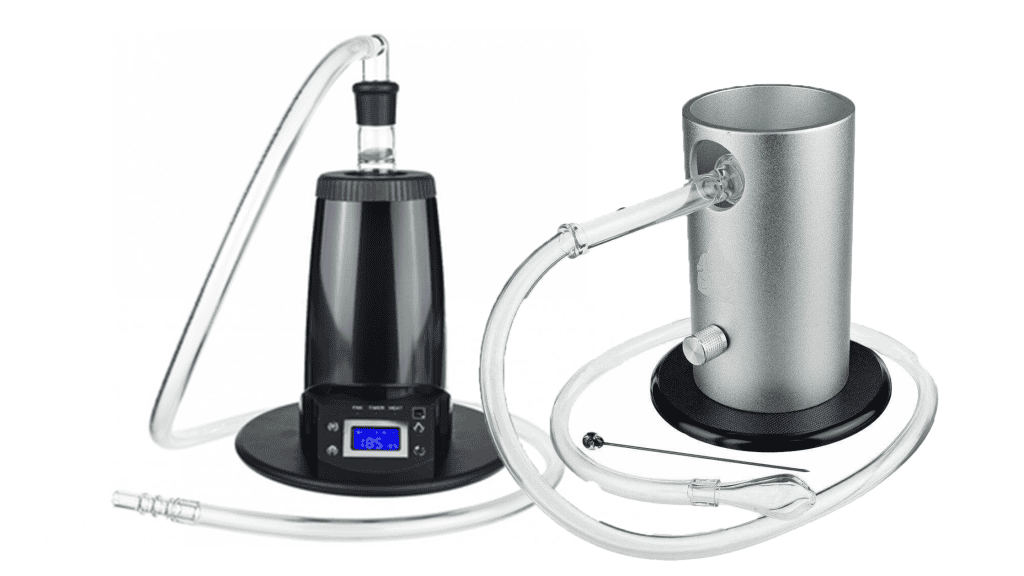
Desktop vaporizers are designed for stationary, at-home sessions, offering superior vapor quality, larger capacity, and consistent performance. When herbal vaporizers first emerged on the market, they were almost exclusively desktop models. These early devices were intended to stay in one place—set up on your coffee table or in a designated sesh spot—not meant to be moved or taken on the go.
Unlike portable vaporizers, (most) desktop units are powered by a wall outlet rather than a battery. This allows for uninterrupted sessions and more consistent heat output. Desktop Vaporizers feature larger chambers, making them ideal for more robust sessions or sharing in social settings. They also tend to offer better vapor production thanks to more powerful heating systems and precise temperature control. Vapor is typically delivered through a whip (a silicone tube you inhale from) or a balloon (a bag filled with vapor), and some units incorporate fan-assisted delivery for ease of use. For concentrate desktop vaporizers you will certainly be inhaling through a water filled chamber.
As the vaporizer market evolved, a wide variety of devices emerged in all shapes and sizes, with many brands marketing larger units as “portable.” This has blurred the lines between desktop and portable classifications. For example, at To the Cloud Vapor Store, we still classify devices like the Puffco Peak and Peak Pro as desktop vaporizers. While more compact than traditional tabletop models, their water filtration systems, glass components, and need for a flat surface during use make them best suited for home sessions. On the other hand, we consider vaporizers like the Arizer Solo models to be portable, even though they’re not pocket-friendly, because they operate on battery power and have large glass stems for drawing.
Today portable vaporizers make up the lion share of the cannabis vaporizer market but if you are only wanting to use at home a desktop vaporizer is the way to go given their superior vapor quality and longevity.
Control
Operating a cannabis vaporizer can run a wild gambit from needing to torch a component of the vaporizer to get vapor to having multiple easy to understand control buttons with a digital display screen. There are vaporizers which use RGB lighting and haptic feedback with a single control button and vaporizers with touch screen controls and some even offer the added ability to control via Bluetooth on a web app.
Single Button Control
Here one button is used for all functions and controls. You will need to learn sequencing and duration of pressing the buttons to command the vaporizer for things such as powering on, changing temperature, checking battery life,etc. To make this process easier on the user there generally is corresponding lighting and haptic feedback to let you know you are doing it right. While this may sound difficult at first after reading instructions and playing around with your vaporizer it becomes second nature.
The funny thing about the single button control is you get accustomed to those controls which will differ from another vaporizer which also utilizes single button control. Some take 3 clicks to power on where others take 5, some one long press of the single control button will do the trick. Then there is the operation which are sequences of button presses. As mentioned once you get the hang of it, it is rather easy. However these vaporizers are not as easy to control as ones with multi button controls and digital display screens.
Multi Button Control
Multi button control makes the vaporizer much easier to use with intuitive controls that don’t require the same learning curve as single button control vapes. These controls generally consist of a main power button and temperature control buttons. Most multi button control vapes offer exact temperature dial in where single button control vaporizers have preset heat settings where dialing in the exact temperature cannot be done unless there is also Bluetooth connectivity.
Bluetooth Control
While no vaporizer is 100% controlled solely via Bluetooth, it is a nice feature many tech savvy vaporizer consumers like to have. Bluetooth control lets you control the basic functions such as changing temperature, visualizing the true battery life, adjusting through different modes and presets and some apps offer insights into your usage history and allow you to session with friends and even play games.
Since iOS has banned vaporizer apps Iphone users must access these apps via web apps built by the manufacturer. This has led to a huge variance in quality of the vaporizer apps with some not so good and others having an amazing app experience.
Draw Activation
Currently you will only find this on the oil vaporizers which are battery activated pod vaporizers. This is the nicest way to enjoy vapor by simply inhaling and not having to worry about any controls whatsoever. This would be hard to build into an herb vaporizer or high end E-Rig.
Torch/ Induction Heating Controlled
Some users swear by these for the best vapor while others will really struggle to get consistent and quality vapor. To the Cloud Vapor Store is yet to sell any of these as our guiding principles around vaporizers advocate for ones which do not require any external meddling with needing to use a torch to get vapor.
Heating Method
Conduction
Conduction heating is when your herbs or extracts are heated via direct contact with the oven (herb chamber), atomizer or coil. Conduction heating provides consistent heating but also may require stirring mid session if vaping herb to get every last drop of vapor from your herb.
Convection
Convection heating works by having hot air passing over or though your herb or concentrates. This means the heating source has a stand off distance from your material and the action from you drawing or a fan assist are what causes the hot air to pass through the material to produce vapor. This method is seen as preserving more material and does not require mid session adjustments but also makes the heat transfer take longer making for slower vapor production over a session.
Hybrid
Most Vaporizers in one way or another have components of both heating types. We, at To the Cloud Vapor Store, classify hybrid as having proper dual heating elements for both convection and conduction.
While we say the definition can be confusing or at least nuanced is that a pure convection vaporizer over a long session will eventually have the chamber get hot enough that the direct contact with the herb will take on convection heating properties (making the air in the chamber so hot that even material not in direct contact with the heat will begin to heat) and vice versa.
For example, in E-rigs the 3D heating element will make internal chamber air hot despite the heat only coming from the bottom and walls of the chamber especially if using terp pearls or a joystick carb cap. Then there is the stand off distance argument. How much contact or stand off distance from the heating element constitutes conduction or convection.
Induction
Induction heating heats your material super fast via a conductive material (like metals) using electromagnetic fields, rather than direct contact with a heat source. This heats up your material super fast and will not begin heating without the conductive material.
Ball Vapes
While Ball Vapes use the convection heating property, Ball vapes supercharge this by packing the heater head with dense, heat-retaining spheres, which Increase the surface area the air contacts and Boost thermal inertia, so temps stay stable during airflow spikes. While ball vapes are notable for producing some of the best vapor on the market, the set up and moving parts make them very off putting and burdensome. Your significant other may leave you as it looks like you are setting up a meth lab to just vape some weed. They are very impractical to operate with ease but it will be interesting to see if this changes over the years.
Infrared
Unlike traditional conduction or convection methods, infrared vaporizers use radiant heat—specifically infrared light waves—to penetrate the herb and heat it from the inside out. This light-based energy excites the molecules within the plant material, causing them to vibrate and generate heat internally. As a result, the cannabinoids and terpenes are vaporized more evenly and efficiently without the need for direct contact with a hot surface or forced hot air. This method minimizes combustion risk, preserves delicate flavors and aromas, and allows for smooth, consistent draws.
Power & Charging
Vaporizers are powered in many ways. Most modern portable vaporizers use Lithium Ion batteries and recharge via USB-C. Desktop Vaporizers predominantly power via direct plugin to a wall outlet. Then there are vaporizers which are powered via butane torches or induction heating.
Within these charging structures there is then vaporizers that have removeable batteries or internal batteries, some utilize 18650 batteries while other vaporizers have proprietary batteries.
Internal Battery
Often the most dependable high end batteries which are designed to last for years, internal batteries are found in heavy duty vaporizers such as those from Puffco, Storz & Bickel, PAX and Dr. Dabber.
These are specifically designed batteries that have operational features built in to assist the battery in providing optimal power and preservation for the device.
The downside is internal batteries cannot be removed and replaced. One must instead wait for them to charge which can be time consuming.
External / Removeable Battery
Just as it sounds. These vaporizers allow the user to charge internally or externally. Here you can swap out with ease and don’t have to deal with any downtime if you have spare batteries.
The most popular vaporizer batteries are the lithium ion 18650. An added benefit of external / removable batteries is that you can swap them out with other vaporizer models you may own and they can be charged on external chargers for faster charging.
AC/Plugin Powered
These are your plugin desktop vaporizers which do not use batteries whatsoever. They are plugged into a power outlet and have unlimited power.
A select handful of battery powered vaporizers do offer a pass through charging feature where you can use the vaporizer while it is plugged in. While this is similar to an AC powered desktop vaporizer it is advised to use pass through charging sparingly as it will degrade the battery life overall.
Heat Source Powered
Another no battery or electricity jolt needed to get your session going, these vaporizer will use an external heat source to power them. The most well known vaporizer that is powered this way is the DynaVap line up where a torch or induction heater is used to just as you would for a traditional dab. Currently To the Cloud Vapor Store does not sell any of torch or external heat source powered vaporizers.